Why Some Instruments Have Keys and Others Have Valves
Why instruments have keys or valves? Follow how each control changes pitch, and learn what to listen for in clarinets, pianos and trumpets.
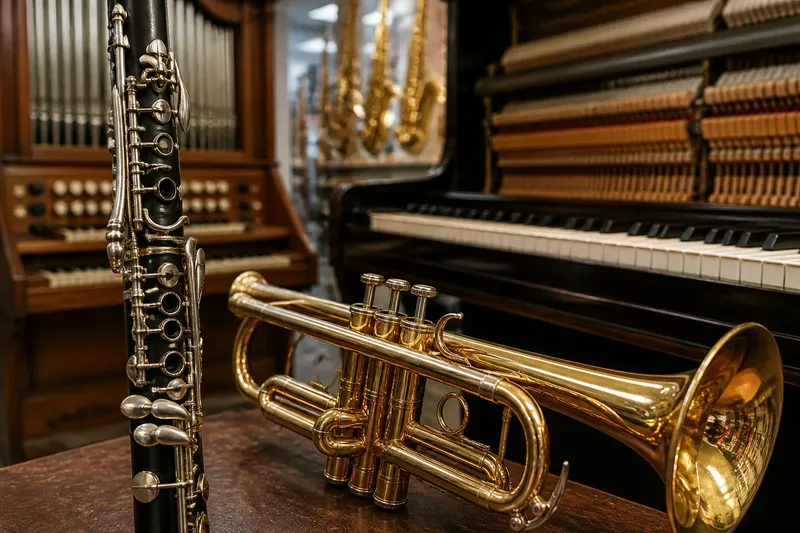
At a music shop, a clarinet’s keys click beneath the fingers while a trumpet’s valves sink into the hand. Why instruments have keys or valves becomes clearer when you follow what each control changes: a key can operate a hole or an action, while a valve redirects air through tubing.
These controls are not interchangeable buttons. Their job depends on how the instrument makes sound, and the same word, “key”, describes quite different mechanisms on a clarinet, piano and organ.
Woodwind keys operate holes through levers
On a recorder, a player’s fingers cover holes directly. Opening a hole changes the effective vibrating air column, generally raising the pitch. Direct fingering becomes awkward when holes are too far apart, too large to cover comfortably, or positioned where a finger cannot reach them.
A woodwind key connects a finger to a pad or another part of the mechanism. Pressing it may close a hole, open one, or move linked parts; springs return the mechanism when the finger lifts. On a clarinet, this lets the player operate holes that are not practical to cover directly and coordinate fingerings across the instrument.
The key itself does not simply choose a pitch in isolation. The combination of open and closed holes affects the air column, while the player’s breath and embouchure help produce and shape the sound.
Keyboard keys trigger different sound-producing actions
A piano key moves a mechanism that causes a hammer to strike strings. An organ key typically opens a valve or otherwise permits air to reach selected pipes, according to the organ’s design and registrations. Neither action works like a clarinet key opening a hole along one shared tube.
On both instruments, the keyboard arranges controls in a repeating row, but a pressed key triggers an instrument-specific action. A piano’s hammer excites strings; an organ’s action admits air to pipes. This distinction explains why the word “key” alone does not tell you what moves or how pitch changes.
Brass valves change the route through tubing
On a trumpet, the player’s lips vibrate against the mouthpiece, and the instrument’s tubing helps support resonant pitches. Pressing a valve redirects air through additional tubing. That changes the instrument’s effective tube length and the resonances available to the player.
A valve does not produce a fixed note by itself. The player still shapes the vibration with lips and breath, selecting among the pitches supported by the current tubing route. Releasing or combining valves changes that route again.
This differs from a woodwind key, which operates holes or linked mechanisms, and from a piano key, which triggers a hammer action. Each control makes sense within its instrument’s sound-making system.
Instrument design shapes the control it needs
Woodwind keywork helps place and operate holes for acoustic and practical reasons, rather than limiting every hole to the reach of a fingertip. Levers, pads and linkages let players manage openings that would otherwise be difficult to cover or coordinate.
Brass instruments need a way to alter the route through a continuous tube while the player keeps the mouthpiece in place. Valves provide that change in tubing configuration. These approaches are not steps in a contest to make one instrument better; they answer different mechanical needs.
What should you listen for in keys and valves?
Why does a clarinet have so many keys?
Its holes cannot all be placed within comfortable fingertip reach, and the player needs to manage openings in combinations. Keys connect fingers to those holes and make the instrument’s range of fingerings practical.
Do trumpet valves make the note by themselves?
No. A valve changes the tubing route, while the player’s lips vibrate and breath sustains and shapes the sound. Listen for how the player’s valve choices work with those physical adjustments.
Why does a piano use keys rather than valves?
A piano produces sound when hammers strike strings, so its keys trigger a hammer mechanism. Valves redirect air through tubing, which is not the piano’s sound-producing system.
Do all keys work in the same way?
No. A clarinet key operates a hole or linked mechanism, a piano key moves a hammer action, and an organ key typically controls the admission of air to pipes. The name describes the player’s control, not one universal mechanism.
Follow one finger movement from control to sound
Say you are comparing a clarinet and a trumpet in a music shop. On the clarinet, you see a player press a key and a pad close a hole; the changed opening alters the air column, so a different pitch or response may follow, depending on the fingering. On the trumpet, the player presses a valve and air takes a longer route through tubing; this changes the resonances available, but the player’s lips and breath still determine which one sounds.
In each case, watch the mechanism and then listen to the result. The visible movement explains one part of the note change, not the whole performance.
Use the mechanism to listen more closely
When a key clicks or a valve moves, ask what it actually changes: a hole, a hammer action, an organ’s air admission, or the route through brass tubing. That question keeps unlike mechanisms distinct while connecting each one to the sound it helps produce.
Next time you hear a woodwind run or brass phrase, follow one changing pitch from the player’s hand to the sound. Why instruments have keys or valves is not a single mechanical rule: keys operate different actions according to the instrument, while brass valves redirect air through tubing.